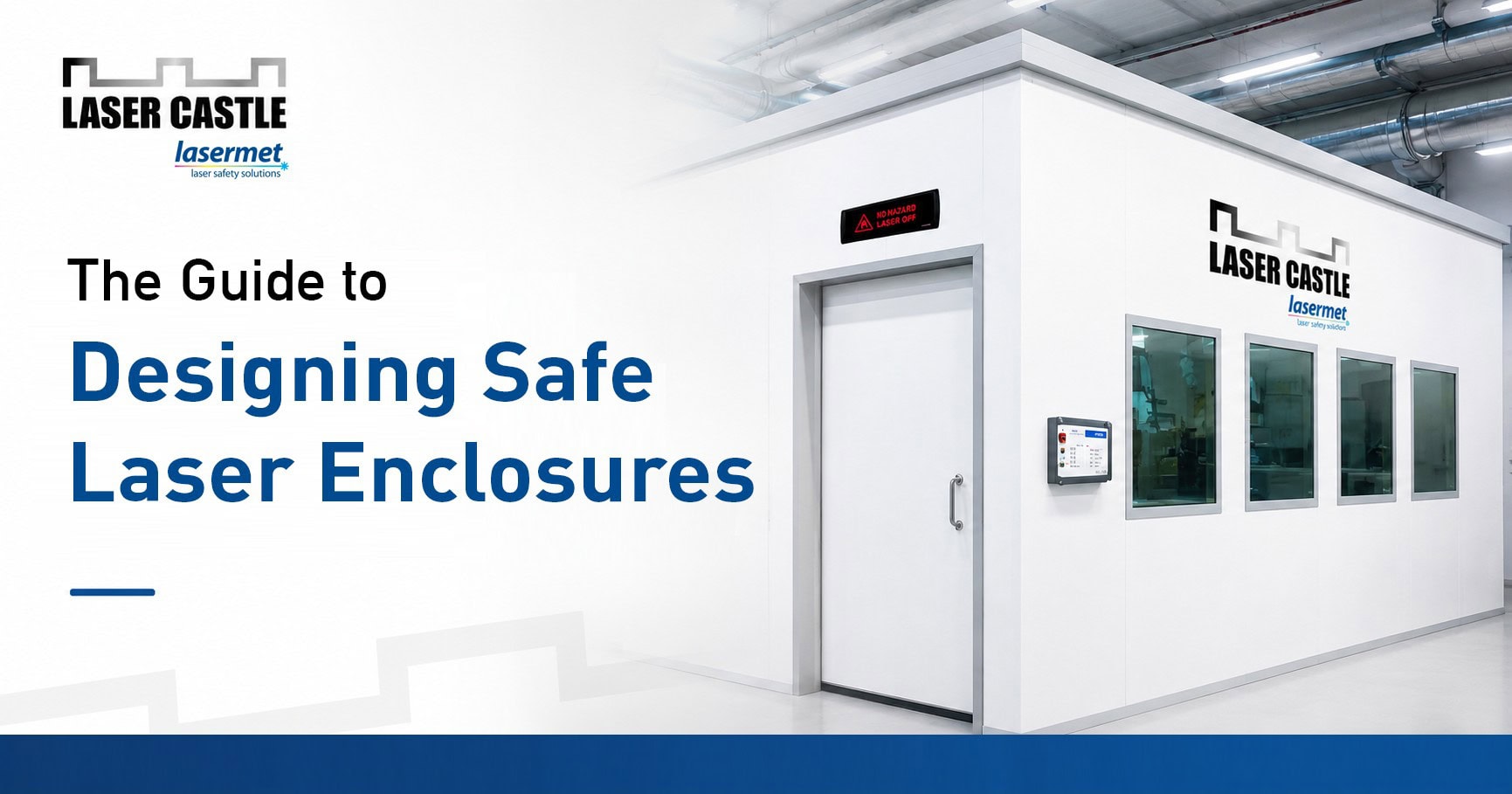
A laser enclosure is far more than a box around a laser. A properly designed enclosure forms the foundation of a laser safety system, controlling access to hazardous areas, containing direct and reflected laser radiation, and integrating with safety systems that prevent exposure. Poor enclosure design can undermine even the most sophisticated laser equipment, while a well-designed enclosure can transform a Class 4 laser installation into a controlled and compliant working environment.
At Lasermet, we design and manufacture complete laser safety solutions, from modular laser safety cabins and laser blocking curtains to high-integrity interlock systems, safety shutters, warning signs, and control equipment. The result is a complete safety ecosystem designed to meet the requirements of international laser safety standards.
Designing a Safe Laser Enclosure
The primary purpose of a laser enclosure is to create a Laser Controlled Area (LCA) where access is restricted and laser hazards are contained. IEC TR 60825-14 recommends the use of engineering controls such as enclosed beam paths and laser-controlled areas as the preferred means of reducing risk.
The first consideration is always the laser itself. Designers must understand:
- Laser classification
- Wavelength(s)
- Output power and energy
- Pulse duration
- Beam diameter and divergence
- Operating modes
- Potential fault conditions

These parameters determine the Foreseeable Exposure Limit (FEL) that the enclosure must withstand. Under IEC 60825-4, laser guards must be designed with a Protective Exposure Limit (PEL) sufficient for the application. Lasermet routinely performs these calculations when specifying enclosure materials for customers.
Containment of Direct and Reflected Radiation
Many laser incidents occur not from the direct beam but from unexpected reflections.
When designing an enclosure, consideration must be given to:
- Direct beam strikes
- Specular reflections
- Diffuse reflections
- Misalignment events
- Component failures
- Maintenance activities
The enclosure walls, doors, viewing windows, curtains, and beam stops must all be capable of containing foreseeable laser radiation.
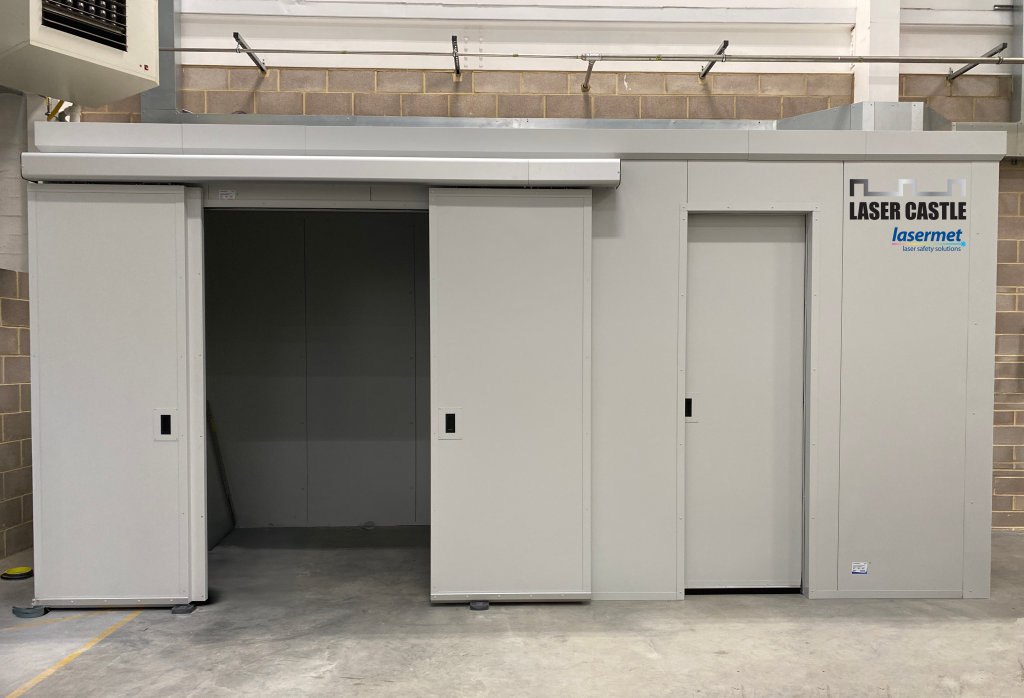
Lasermet’s laser blocking panels, Laser Castle systems, laser blocking curtains, and certified viewing windows are designed specifically for this purpose. In many installations, laser blocking screens and other barriers are also used to provide additional protection against unexpected beam paths. This approach is commonly employed in installations where beam directions may change depending on operational mode.
Line-of-Sight Considerations
One of the most overlooked aspects of enclosure design is line-of-sight.
An enclosure should be designed so that personnel cannot view hazardous laser radiation through open doors, access points, ventilation openings, or inspection windows.
Good design practices include:
- Positioning doors away from beam paths
- Using beam dumps behind targets
- Incorporating labyrinth entrances or baffles where practical
- Installing laser blocking screens near access points
- Preventing direct beam paths towards windows and doors
In large laser laboratories, physical barriers are often used inside the enclosure to separate beam paths from operator walkways. This creates multiple layers of protection should a beam become misaligned.
Lasermet frequently incorporates internal screens and beam containment structures to eliminate line-of-sight exposure risks while maintaining operational flexibility.
Interlocked Access Control
A laser enclosure is only as safe as its access control system.
For Class 4 laser installations, access doors should typically be interlocked so that opening a door automatically disables laser emission.
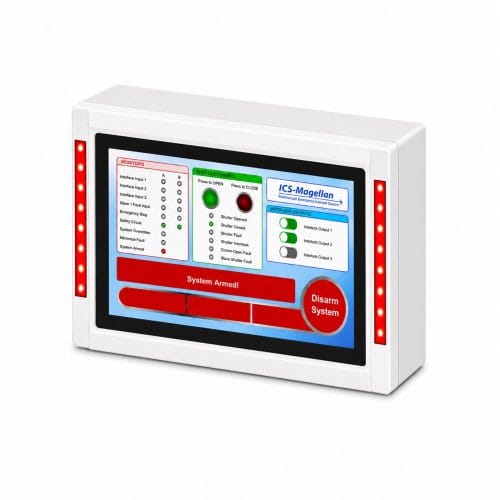
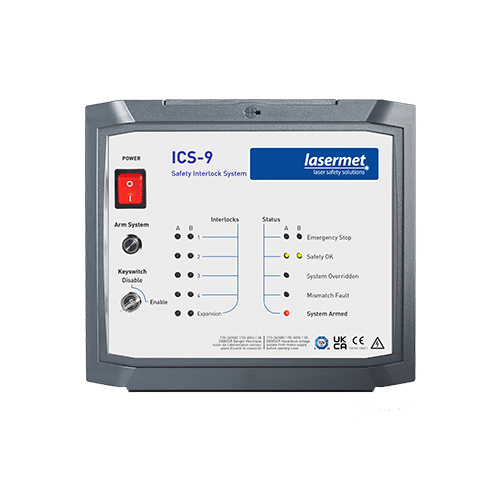
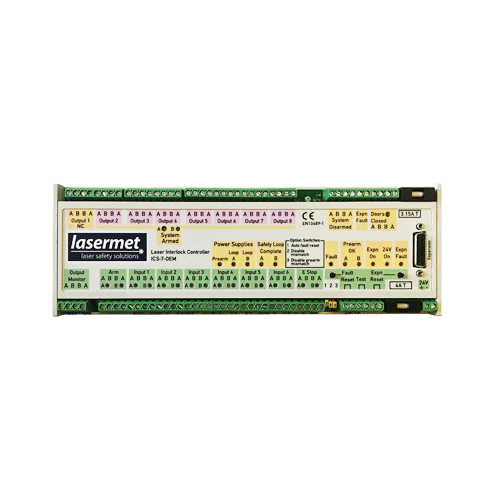
Modern systems use dual-channel safety architecture to achieve high levels of functional safety. Lasermet’s ICS-9 Interlock Controller forms the heart of many laser safety systems and can monitor any and all interlock devices in the laser-controlled area.
When a monitored device enters an unsafe state, the system automatically disables the laser source.
For higher-risk installations, monitored door locks can prevent access while the laser is armed, while emergency break-glass devices provide immediate escape routes during emergencies.

Emergency Stops and Exit Routes
Every laser enclosure must allow personnel to exit safely in an emergency.
Emergency stop devices should be positioned:
- Near exits
- At operator stations
- Along personnel routes
- Adjacent to hazardous equipment
Emergency break-glass units or emergency release devices should be provided where doors are electrically locked.
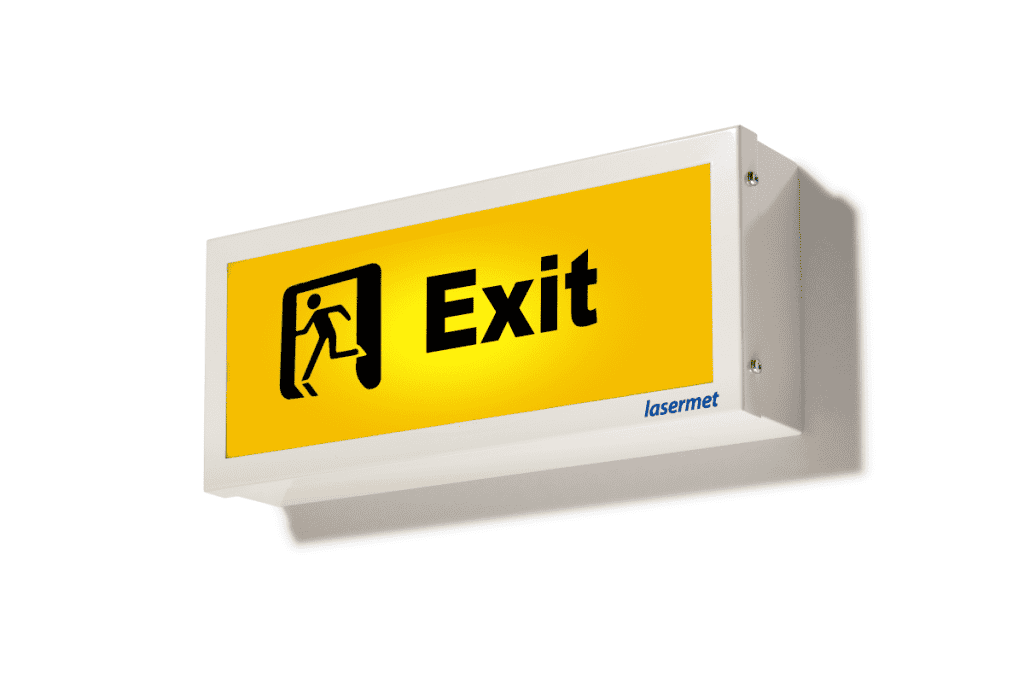
Lasermet systems routinely incorporate dual-channel emergency stop devices and monitored emergency exit systems to ensure personnel can always leave the enclosure safely while simultaneously disabling hazardous laser emission.
Laser Safety Shutters
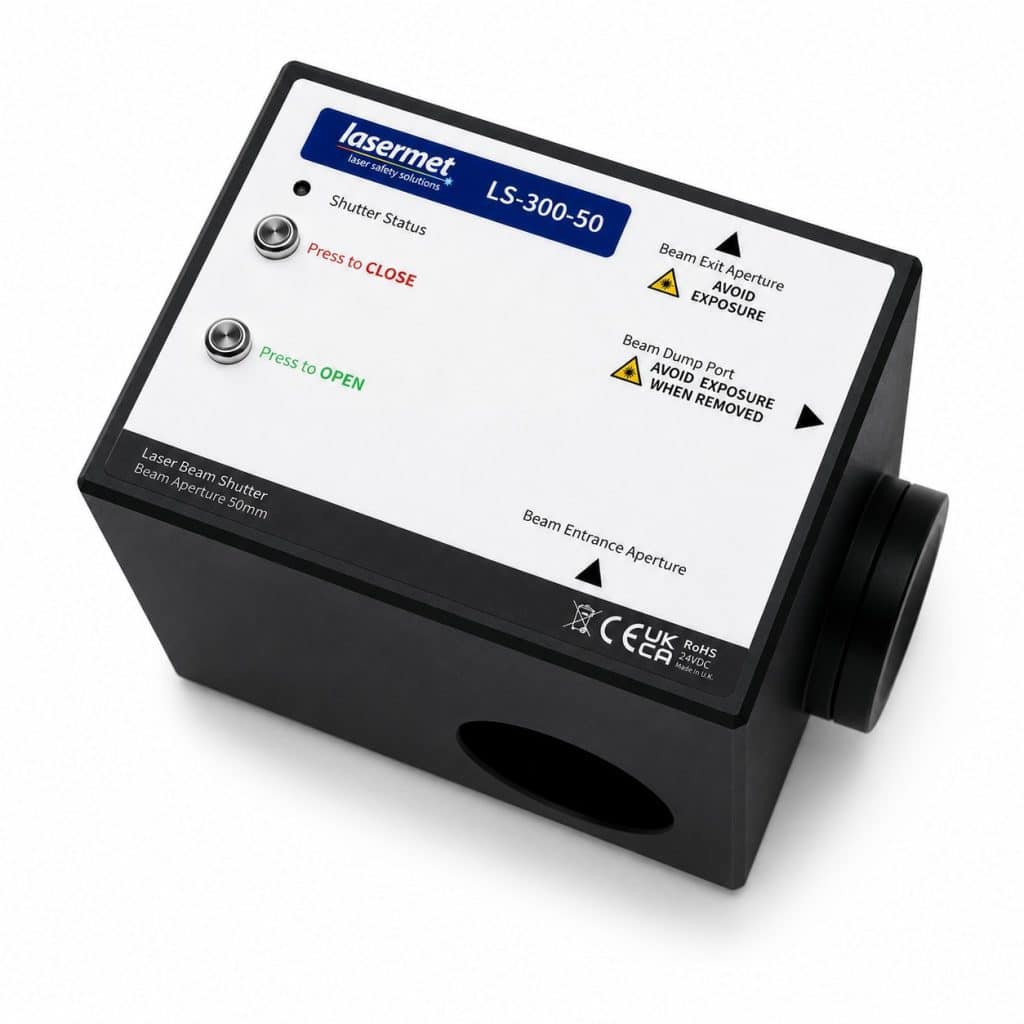
Laser safety shutters provide an additional layer of protection and are often required for beam containment and controlled operation.
Unlike process shutters, safety shutters must fail to a safe state.
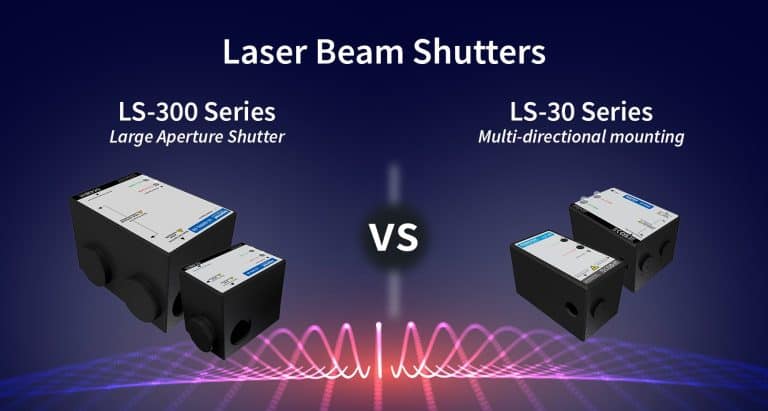
Lasermet’s series of laser safety beam shutters feature:
- Dual-channel architecture
- Positive position monitoring
- Force-disconnect proving contacts
- SIL3 and PLe capability when integrated correctly
These shutters are commonly integrated into interlock systems so that any safety fault automatically closes the beam path.
Ventilation and Fume Extraction
Laser processing applications frequently generate:
- Welding fumes
- Cutting fumes
- Vapours
- Smoke
- Airborne particulates
- Hazardous gases
Ventilation openings can unintentionally create laser leakage paths if not properly designed. Common solutions include light traps, baffled ducting, labyrinth ventilation paths, and/or laser-rated extraction systems. Ventilation design must ensure that no direct line-of-sight exists between hazardous laser radiation and occupied areas outside the enclosure.
Where laser processing generates hazardous airborne contaminants, ventilation systems may also need to comply with local occupational health regulations in addition to laser safety requirements.
Warning Systems and Signage
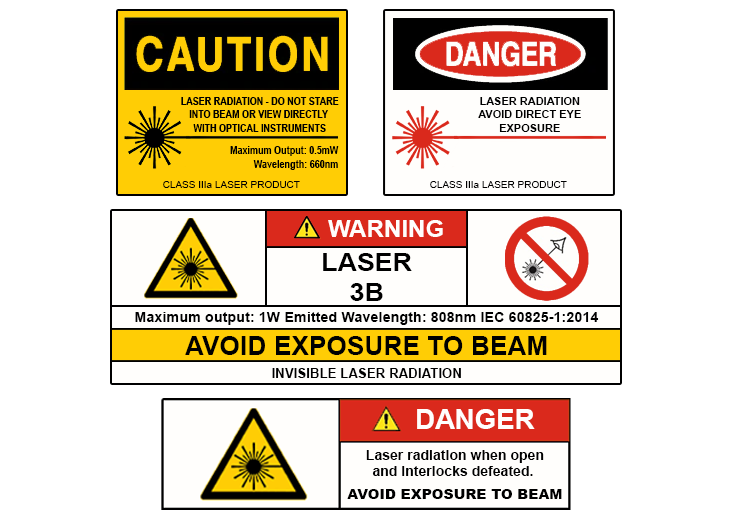
Personnel must be able to determine the status of the enclosure before entering.
Laser safety systems should include:
- Illuminated warning signs
- Audible alarms
- Hazard status indicators
- System status displays
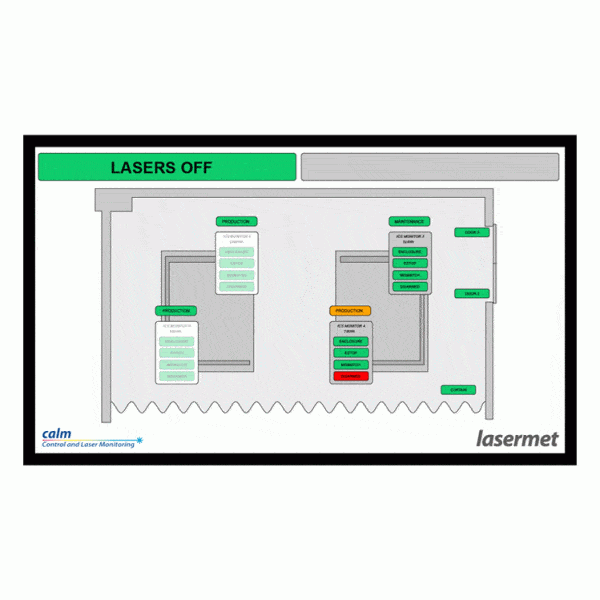
Lasermet LED warning signs automatically display the operational status of the laser system, changing between safe and hazard conditions under control of the interlock system. In larger facilities, networked displays can show system status, operating modes, search status, and active wavelengths throughout the installation.
Compliance Requirements
A compliant laser enclosure typically requires consideration of multiple standards.
IEC 60825-1
Laser product classification and safety requirements.
IEC 60825-1 is the primary international standard for laser product safety. It defines laser classifications, Accessible Emission Limits (AELs), labelling requirements, and the engineering controls required to ensure safe operation of laser systems.
IEC TR 60825-14
Guidance on the safe use of lasers and establishment of laser controlled areas.
IEC TR 60825-14 provides practical guidance for laser users and safety officers on implementing safe working practices. It covers risk assessment, Laser Controlled Areas (LCAs), administrative controls, personal protective equipment, and engineering safeguards such as enclosures and interlocks.
IEC 60825-4
Requirements for laser guards and enclosure materials, including Protective Exposure Limit (PEL) testing.
IEC 60825-4 specifies the requirements for laser guards, barriers, curtains, windows, and enclosure materials. It requires that protective barriers are capable of withstanding foreseeable laser exposure and introduces concepts such as the Foreseeable Exposure Limit (FEL) and Protective Exposure Limit (PEL).
EN ISO 13849-1
Functional safety requirements for safety-related control systems. Many laser interlock systems are designed to achieve Performance Level e (PLe).
EN ISO 13849-1 defines the requirements for safety-related control systems used to reduce risk. It establishes Performance Levels (PL) from PL a to PL e and is commonly used to assess the functional safety of laser interlock systems, door switches, emergency stops, and safety shutters.
IEC 60204-1
IEC 60204-1 covers the electrical safety of machinery and associated control systems. It specifies requirements for electrical installations, emergency stop functions, protective bonding, wiring practices, and electrical fault protection.
ISO 12100
ISO 12100 provides a structured framework for machinery risk assessment and risk reduction. It requires designers to identify hazards, evaluate risks, and implement appropriate protective measures using a hierarchy of controls that prioritises inherently safe design and engineering controls.
IEC 61508 (where applicable)
IEC 61508 is the foundational functional safety standard for electrical, electronic, and programmable electronic safety systems. It defines Safety Integrity Levels (SIL) and is often referenced when designing high-integrity laser safety systems that require SIL-rated components or safety functions.
IEC 62061 (where applicable)
IEC 62061 applies functional safety principles specifically to machinery control systems. It is commonly used alongside EN ISO 13849-1 for complex automated laser systems incorporating robotics, motion control, and programmable safety devices.
ANSI Z136 Series (North America)
For installations in North America, the ANSI Z136 series provides comprehensive guidance on laser safety, including hazard evaluation, control measures, training requirements, and the responsibilities of Laser Safety Officers (LSOs). These standards are widely regarded as the benchmark for laser safety programmes in the United States.
Depending on the application, additional standards may apply for aerospace, defence, medical devices, automotive manufacturing, additive manufacturing, or robotic systems. Compliance should always be assessed as part of the overall laser risk assessment and system design process.
A Complete Safety System
A laser enclosure should never be considered in isolation. Safe and compliant laser facilities combine multiple layers of protection. Lasermet designs complete turnkey laser safety systems that integrate all of these elements into a single engineered solution. From compact laboratory installations to large aerospace testing facilities, every enclosure is designed around the specific laser hazard, operational requirements, and applicable standards to provide a safe, compliant, and practical working environment.