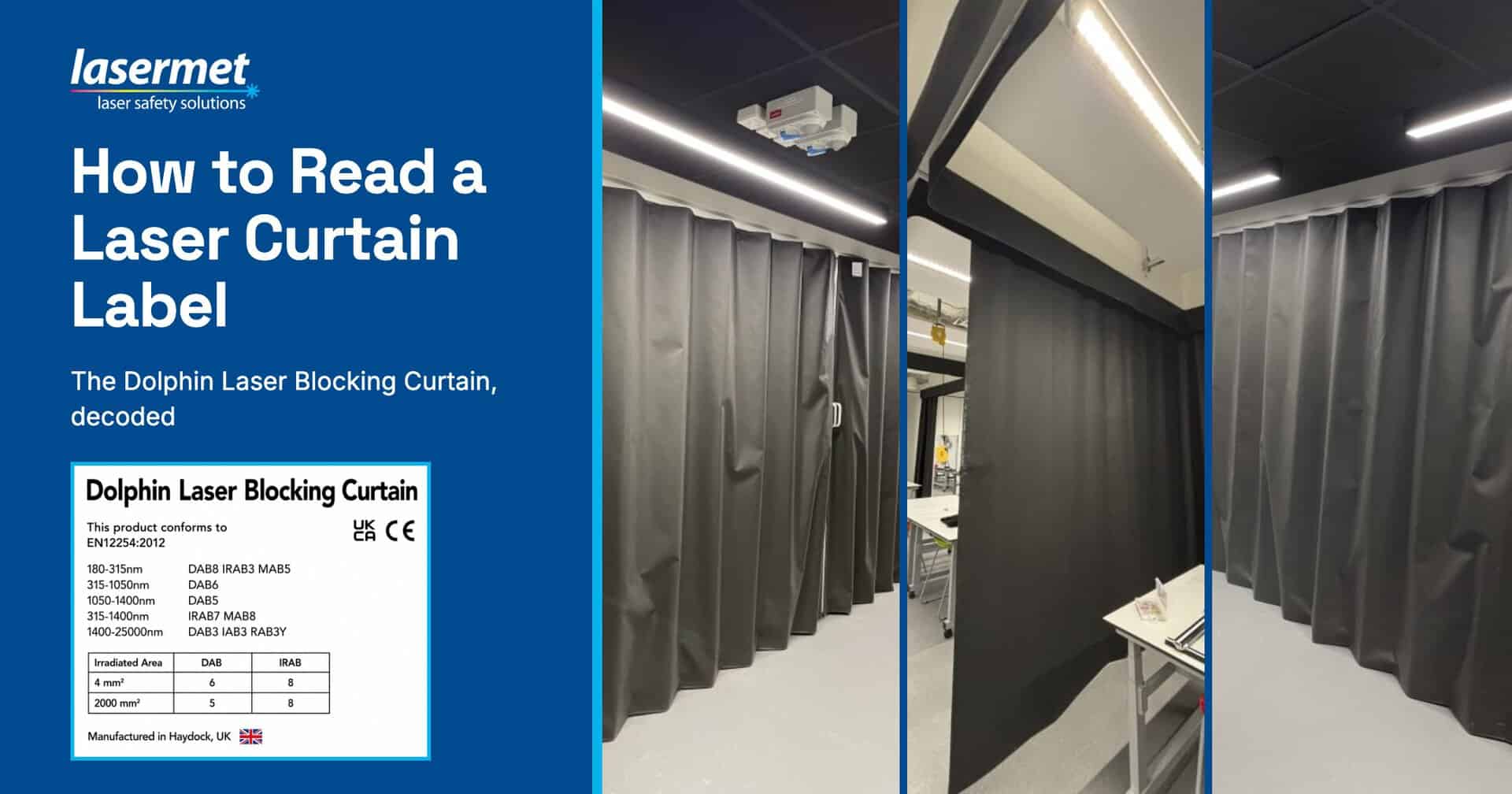
This guide walks through the Dolphin label line by line.
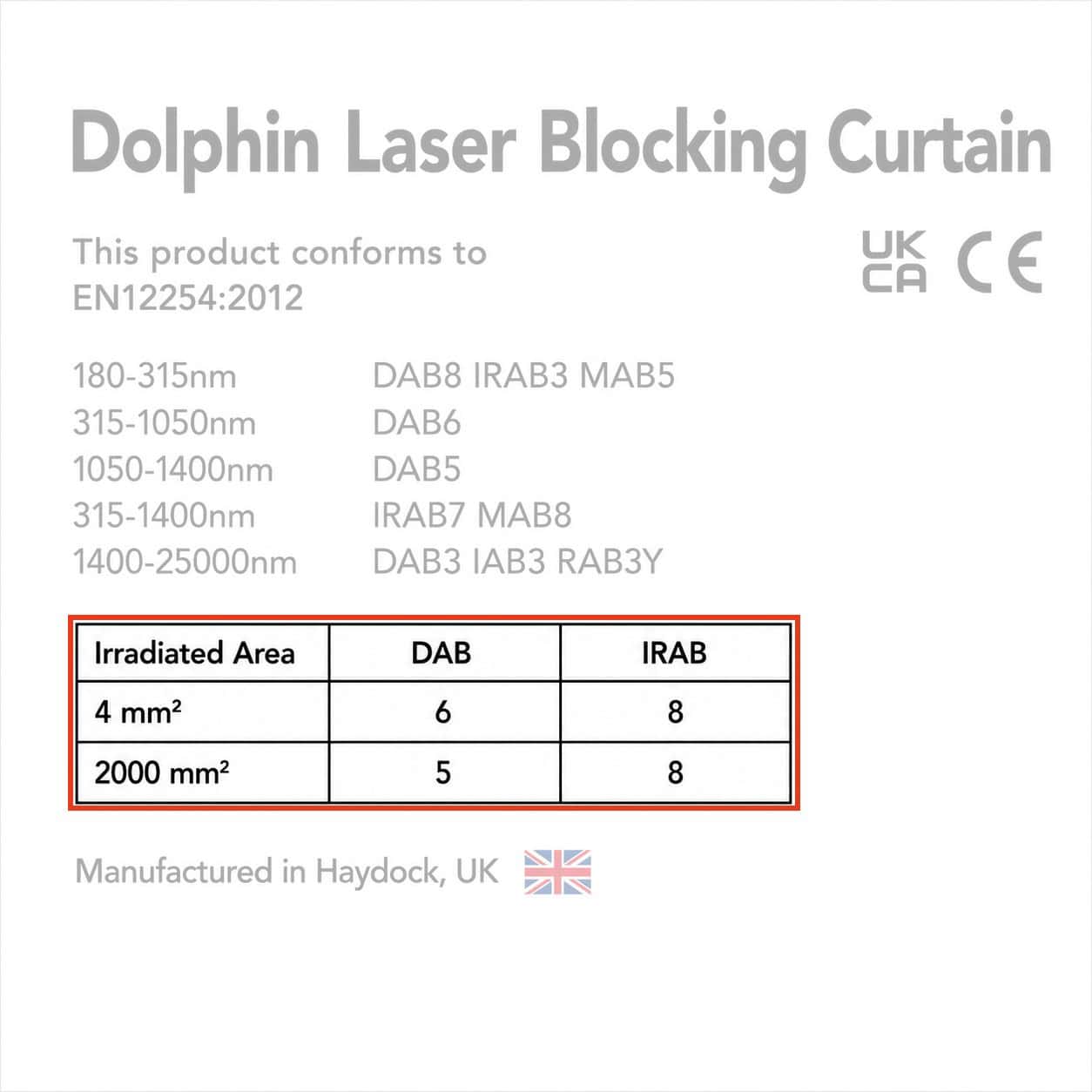
Every Dolphin Laser Blocking Curtain carries a label full of codes like DAB6 and IRAB7. Those codes state which lasers the curtain is certified to block, and how much it can take. Once you can read them, you can check in a minute whether a curtain matches your laser.
The standard behind the label: EN 12254
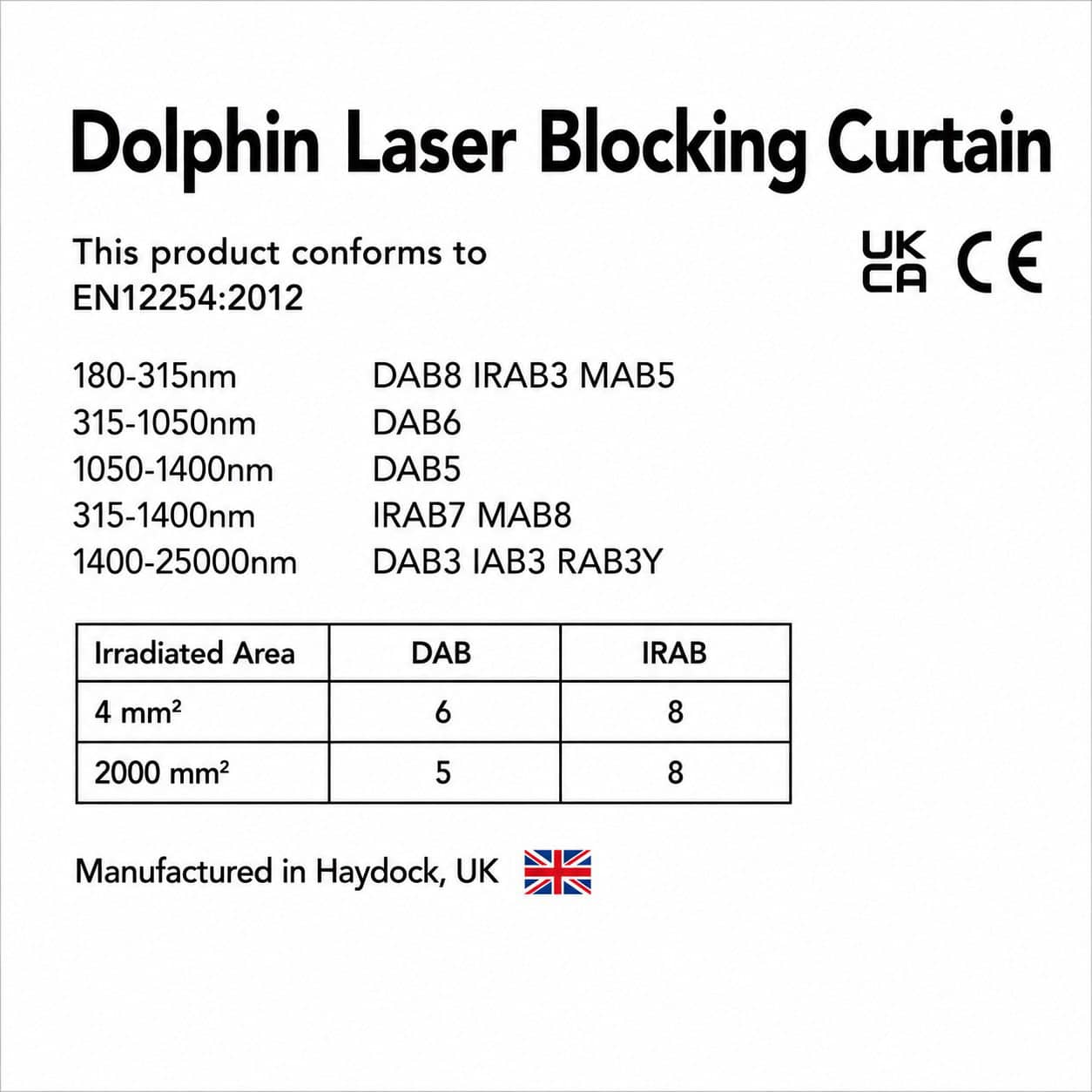
The first line of the label says the curtain conforms to EN 12254, the European standard for screens used at laser working places. It covers curtains, barriers and similar screens that stop stray laser radiation from leaving a laser-controlled area.
To earn a rating, the material is exposed to a laser beam under set conditions for about 100 seconds. If it holds, it is given a protection level for that wavelength range and that type of laser. Those protection levels are the codes on the label.
The UKCA and CE marks beside it show the curtain meets the requirements for sale in Great Britain and the European Union.
Actual Client Installations


How to read an AB code
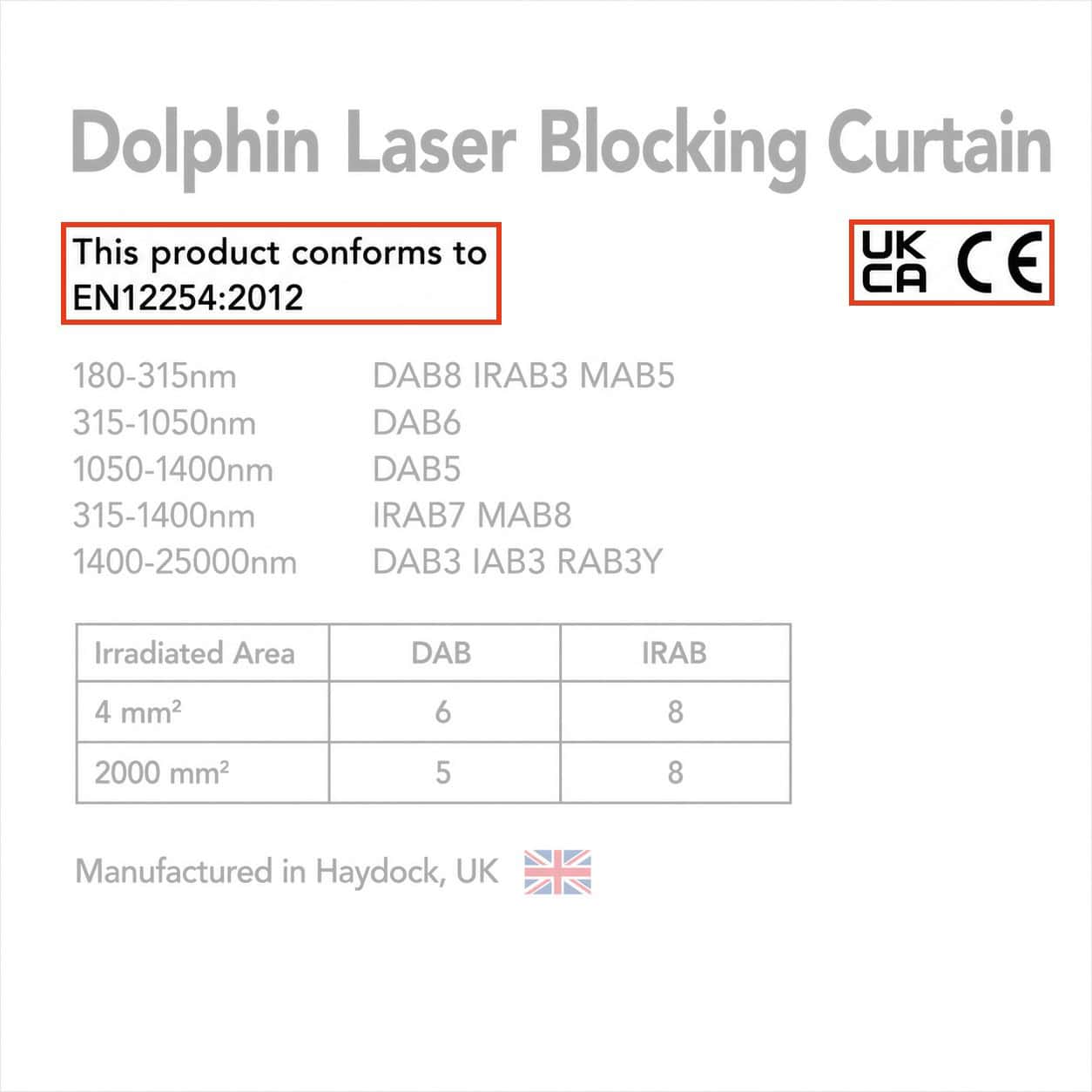
Each code has three parts: a letter for the type of laser, the letters AB, and a scale number. Take DAB6 as the example.
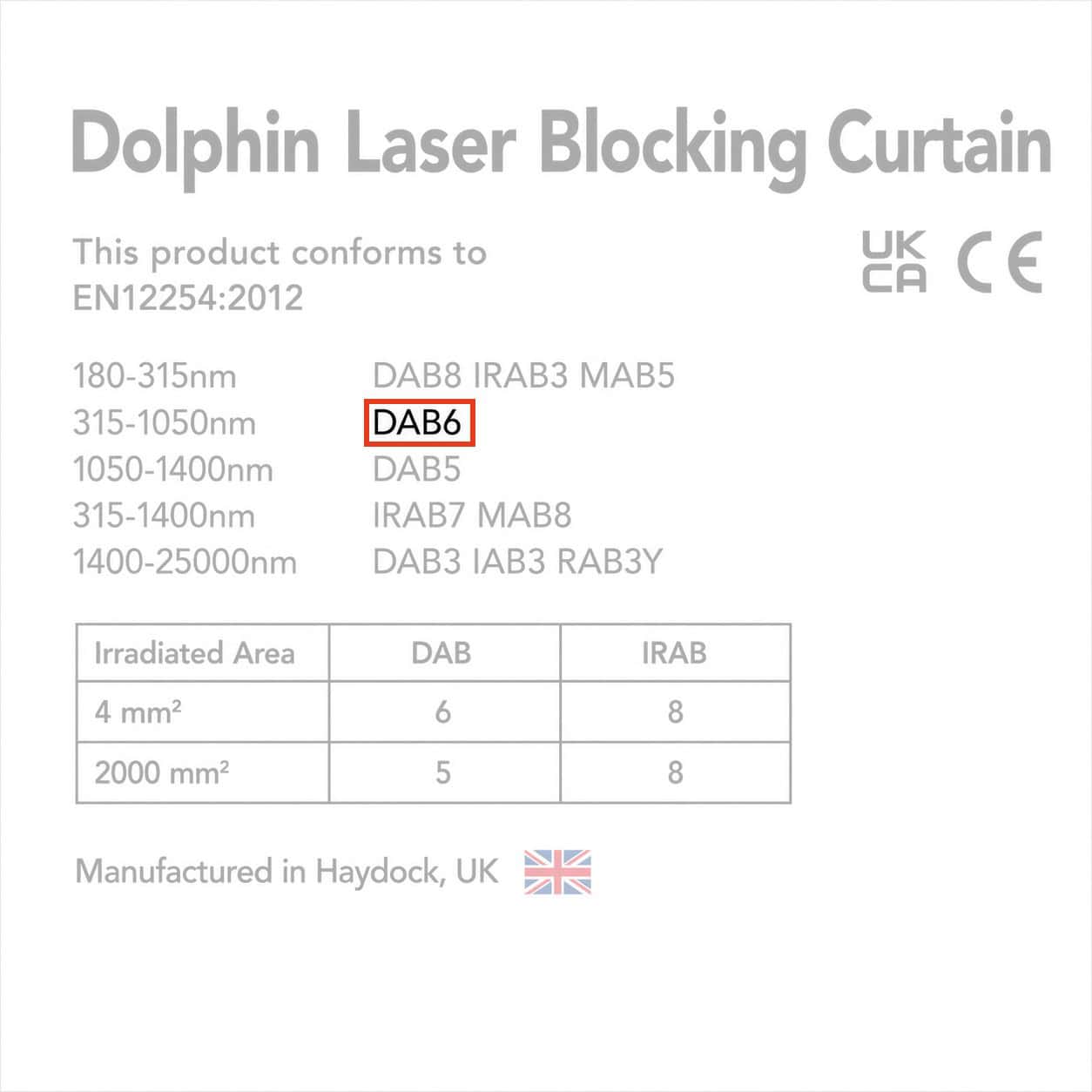
| Part | Example | Meaning |
|---|---|---|
| Laser mode | D | The type of laser the rating applies to |
| Scale | AB | The protection scale for screens, the counterpart of the LB scale on laser safety eyewear |
| Scale number | 6 | The protection level, from 1 to 10 |
The mode letter matters because a material that survives a steady beam may behave differently under short, intense pulses.
| Letter | Laser mode |
|---|---|
| D | Continuous wave |
| I | Pulsed |
| R | Giant pulsed (Q-switched, nanosecond pulses) |
| M | Mode-locked (ultrashort pulses) |
Letters are combined when one rating covers several modes. IRAB7 means level 7 for both pulsed and Q-switched lasers.
Each step up the scale means the curtain is rated for ten times more power or energy density. AB6 is ten times AB5, and a hundred times AB4.
One caution: the scale is set separately for three wavelength ranges: 180–315 nm, 315–1400 nm and above 1400 nm. An AB3 in the far infrared and an AB3 in the ultraviolet are not the same amount of laser power, so compare numbers only within one of those ranges.
The Dolphin’s ratings, band by band
The Dolphin is rated across the whole range from deep ultraviolet to far infrared, 180 nm to 25,000 nm. The label splits that range into bands.
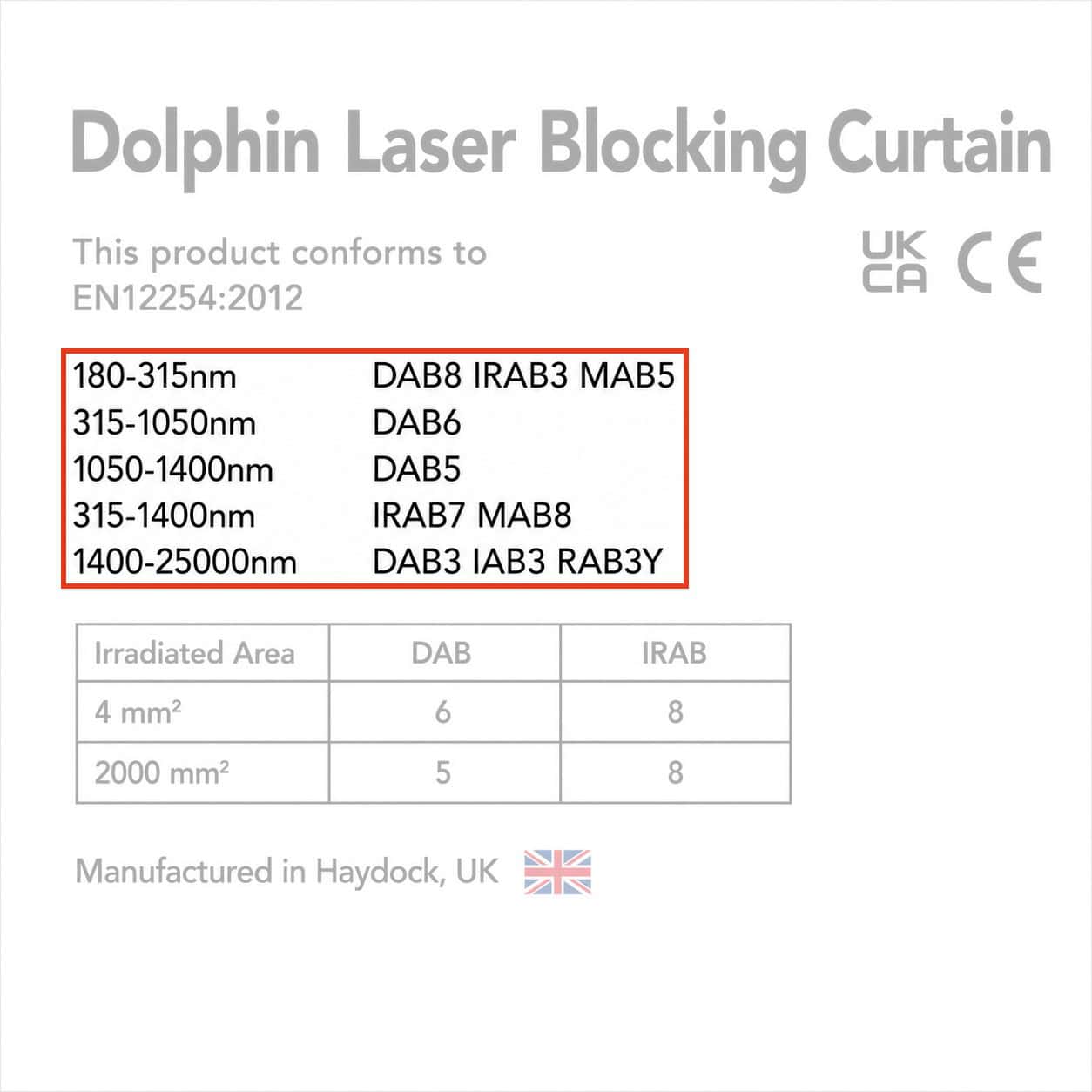
| Wavelength | Rating on the label | Typical lasers in this band |
|---|---|---|
| 180–315 nm | DAB8 IRAB3 MAB5 | Ultraviolet: excimer lasers, 266 nm Nd:YAG |
| 315–1050 nm | DAB6 | Diode lasers, 532 nm green lasers |
| 1050–1400 nm | DAB5 | Nd:YAG at 1064 nm, fiber lasers around 1070–1080 nm |
| 315–1400 nm | IRAB7 MAB8 | Pulsed, Q-switched and ultrafast lasers across the visible and near infrared |
| 1400–25,000 nm | DAB3 IAB3 RAB3Y | CO₂ lasers at 10,600 nm, Er:YAG, thulium lasers |
To use the table, find the band that contains your laser’s wavelength, then find the letter for its mode. A continuous-wave fiber laser at 1070 nm falls in the 1050–1400 nm band, so the rating that applies is DAB5.
That band is the one that matters for handheld laser welding, which is why the Dolphin material is also used in the Dolphin Laser Safety Curtain Pod.
The Y on RAB3Y shows that this rating was not tested at a low pulse repetition rate (25 Hz or below).
Why beam size matters
The small table on the label shows that the rating depends on how large an area the beam hits.
A small spot is easier for the material to survive, because heat spreads into the cooler material around it. A large spot heats a wide patch at once, and the heat has nowhere to go.
That is why the continuous-wave rating drops from 6 to 5 for the larger area. In the near infrared, that is the difference between roughly 10 MW/m² and 1 MW/m².
The pulsed rating is 8 for both sizes.
The practical point: a wide or diverging beam can be a harder test for a curtain than a tightly focused one of the same power density.
What the label does not tell you
The label tells you what the material is certified for, not whether it suits your installation. Three points are worth keeping in mind.
- A curtain protects the people outside it. Anyone working inside the curtained area still needs suitable PPE, such as laser safety eyewear.
- The rating is for a limited exposure. The test lasts about 100 seconds. A curtain is there to stop stray and accidental beams, not to act as a permanent beam stop.
- Wavelength and mode must both match. A high rating in one band says nothing about another. Check the band and the mode letter for every laser used in the area.
The label is one input to a laser risk assessment. Your Laser Safety Officer should confirm that the worst-case exposure at the curtain sits within its rating.
Choosing a Dolphin curtain for your laser
Dolphin Laser Blocking Curtains are made to measure at Lasermet’s factory in Haydock, UK, and supplied ready-made for ceiling or wall mounting. The material is matte black on both sides, so it works as a blackout curtain too, and it meets the fire safety requirements of EN 1598, Section 4.4.
For handheld laser welding, the same material comes as a modular enclosure, the Dolphin Laser Safety Curtain Pod or the lighter version which is the Dolphin Pod Lite.
Not sure whether the Dolphin’s ratings cover your laser? Send Lasermet your wavelength, power and beam details, and the team will help you match a curtain to your application.