What is a laser blocking curtain?
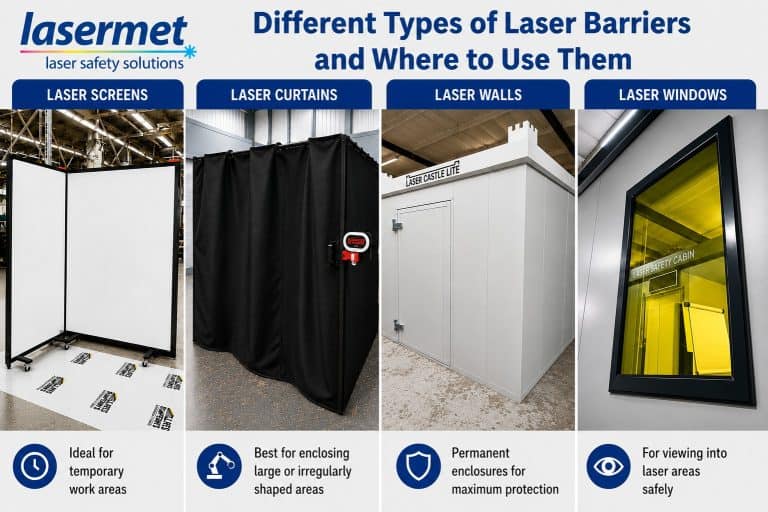
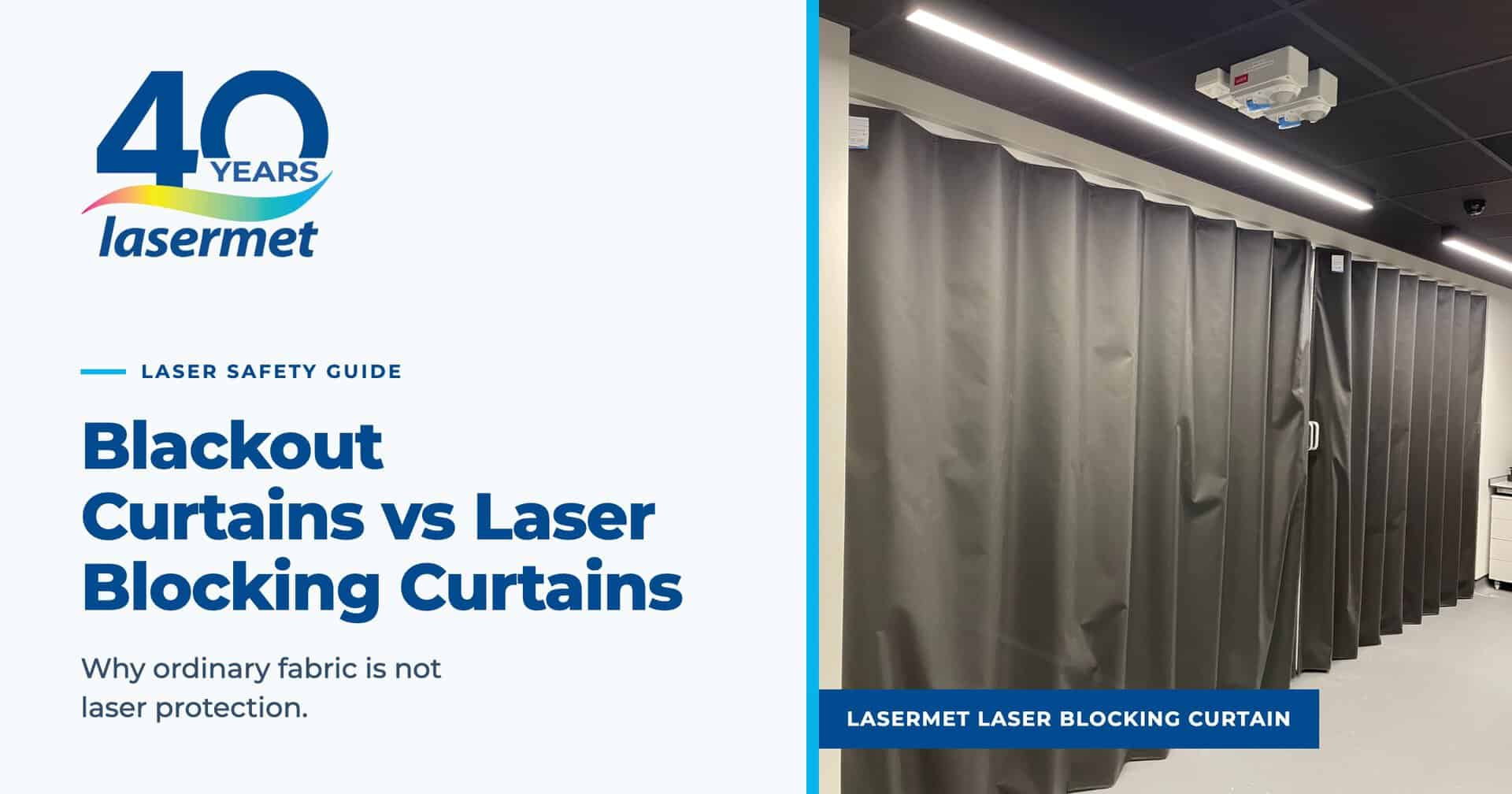
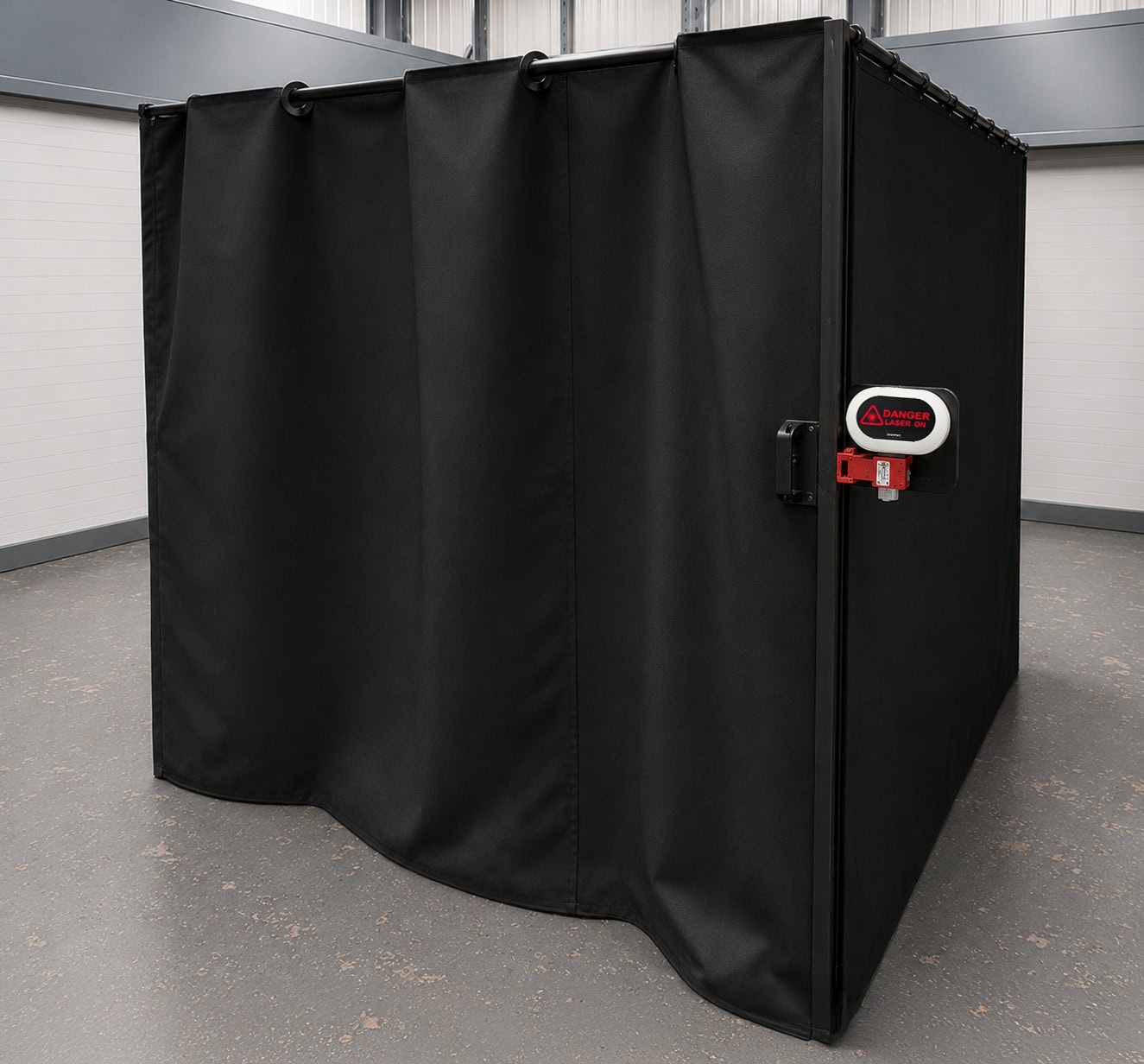
A laser blocking curtain is a passive laser guard made from specially engineered material that stops laser radiation from passing through it. It hangs from a ceiling or wall track like any curtain, but its job is to contain direct, stray and reflected beams inside a laser-controlled area.
Curtains are used in two ways:
- Accidental exposure protection – catching a misdirected beam long enough for it to be noticed and switched off.
- Long-term blocking – permanently enclosing an area where lower power densities hit the material repeatedly.
How performance is measured
A certified curtain is rated by its Protective Exposure Limit (PEL): the irradiance (power per unit area) the material can withstand for a set time without the beam getting through. Ratings are usually given for 10 seconds (T3) and 100 seconds (T2), at both a small spot (4 mm²) and a large spot (2000 mm²). The higher the PEL, the more powerful the laser the curtain can safely contain.
The standards that matter
- BS EN IEC 60825-4 – Safety of Laser Products, Part 4: Laser Guards. Covers passive guards such as curtains and screens.
- EN 12254 – Screens for Laser Working Places. Covers screens used around laser work areas such as welding and cutting.
A curtain that carries one of these certifications, a CE or UKCA mark and a test label has been proven against a defined laser exposure. One without them is just fabric.


Actual Client Installations of Lasermet’s Laser Curtains


Blackout curtain vs laser blocking curtain
A blackout curtain stops daylight; a laser blocking curtain stops a concentrated beam of energy. They can look alike on a rail, but they are built and tested for very different jobs.
| Ordinary blackout curtain | Certified laser blocking curtain | |
|---|---|---|
| Designed to block | Ambient visible light | Direct and stray laser radiation, including invisible UV and IR |
| Material | Woven fabric, often with a foam or polymer coating | Specially engineered laser blocking material |
| Tested against lasers | No | Yes, to BS EN IEC 60825-4 or EN 12254 |
| Rated protection | None stated | Published PEL or protection levels per wavelength |
| Behaviour when hit by a beam | Can scorch, melt, burn through or ignite in seconds | Withstands the rated exposure for 10 s or 100 s |
| Fire performance | Varies; often not rated | Fire-rated material (e.g. NFP 92-503 M2) |
| Labelling | Care label only | CE / UKCA marked with certification label |
| Suitable for a laser-controlled area | No | Yes |
Why a blackout curtain fails
Looking dark is not the same as stopping a laser. Many industrial and medical lasers work in the infrared, which human eyes cannot see. A fabric that blocks visible light may still let IR energy heat, burn or pass straight through it.
Even where a beam does not pass through, the energy has to go somewhere. An untested fabric can scorch or catch fire, turning a stray beam into a second hazard. And with no certification, there is no evidence to show an auditor or laser safety officer that the boundary is safe.
Lasermet’s own guidance puts it simply: ordinary curtains are rarely capable of stopping a laser beam, so certified laser blocking material must be used. The good news is that certified laser curtains also double as blackout screens, so you do not lose that benefit.
Conclusion
A blackout curtain and a laser blocking curtain may hang the same way, but only one is built to stop a beam. Blackout fabric is made to keep a room dark; it has no rated protection, no laser certification and no predictable behaviour when hit by concentrated energy, especially invisible infrared.
A certified laser curtain is a tested safety barrier. It carries a published PEL or protection level, a fire rating and a certification label that proves to auditors and laser safety officers that the boundary will hold for a known time.
If lasers are in use, an ordinary blackout curtain is a false economy that leaves people outside the area exposed. A certified laser blocking curtain gives you both: the blackout effect you want and the laser protection the law and your staff require.