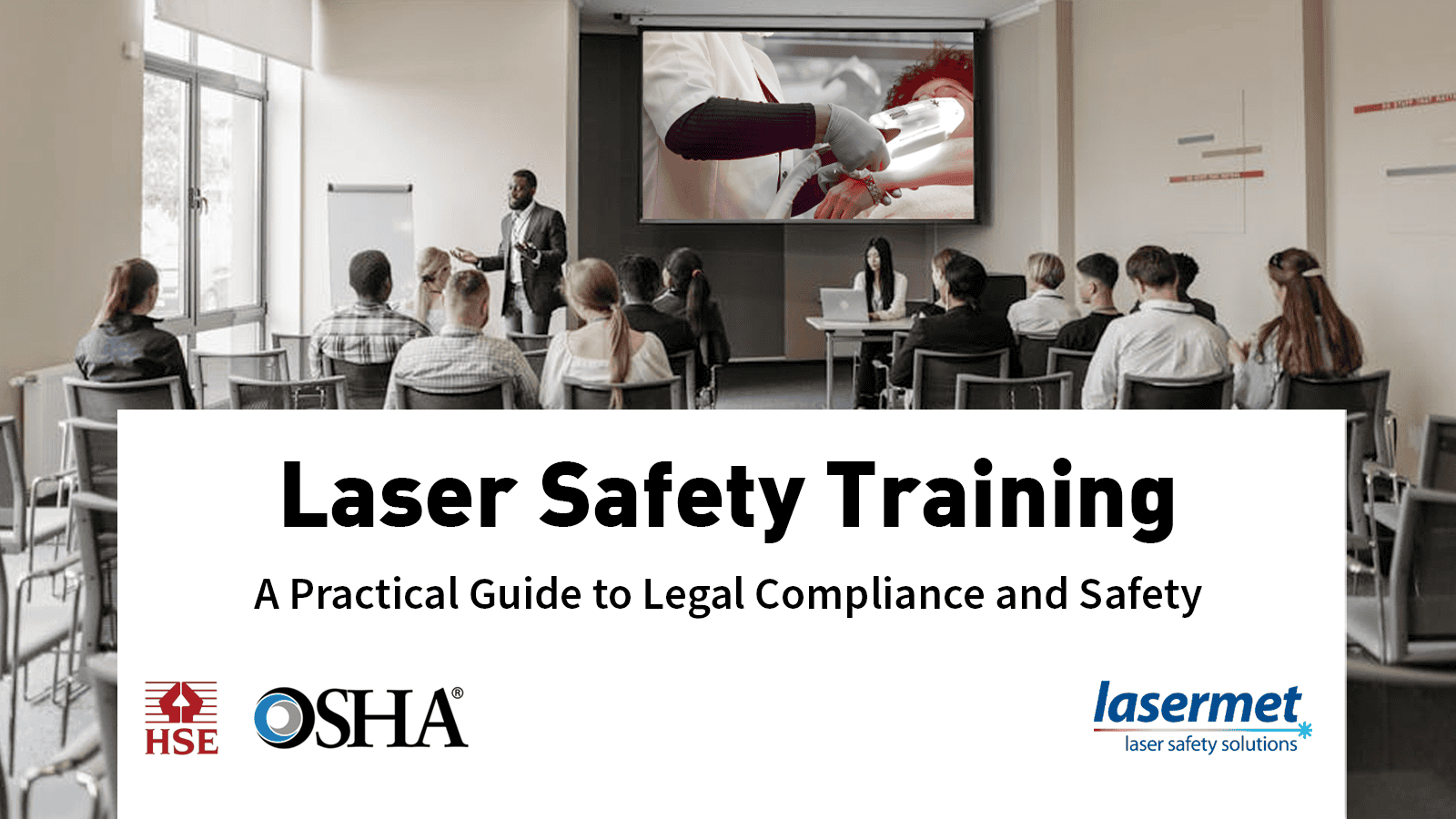
Practical, legal, and safety-focused training for anyone who uses or operates lasers is essential to prevent serious injuries, fire hazards, and legal liability. Requirements vary by region and jurisdiction, but all major governing bodies require laser users to undergo training tied to hazard level and workplace safety law.
In this article, we’ll break down the training requirements for the United Kingdom, the United States, the European Union, and a quick look at the rest of the world.

United Kingdom
In the United Kingdom, laser safety training is mandatory per law under the Control of Artificial Optical Radiation at Work Regulations 2010 (SI 2010/1140). This regulation is the UK implementation of EU Directive 2006/25/EC on the minimum health and safety requirements regarding the exposure of workers to risks arising from physical agents, which includes artificial optical radiation.
This regulation states that employers must protect workers from hazards caused by sources of artificial optical radiation, including lasers. This includes providing workers with information and training proportionate to risk.
It must be noted that although SI 2010/1140 lays out these laws, it does not specify any particular training syllabus.
The employer must ensure that any person, whether or not that person is an employee, who carries out work in connection with the employer’s duties under these Regulations has suitable and sufficient information and training.
Section 5 of Control of Artificial Optical Radiation at Work Regulations 2010 (SI 2010/1140)

UK Health & Safety Executive (HSE) guidance further confirms that all laser users must receive appropriate training based on risk assessments and local rules of the workplace laser area. For Class 3B and Class 4 laser users, training typically includes hazard recognition, control measures, and PPE use.
Certain businesses will also require an employee to fulfil a specific role like the Laser Safety Officer (LSO) which requires more in-depth advanced training.
The role of Laser Safety Officer is described and specified in the British Standard PD IEC/TR 60825-14:2022 which states that all organisations using Class 3B or 4 lasers MUST appoint a Laser Safety Officer (although an LSO may also be appointed for other laser classes if circumstances create a particular hazard).
Medical, Clinical, and Aesthetic laser use in the UK
In medical or aesthetic laser settings, the role of Laser Protection Supervisor (LPS) is broadly equivalent to the role of LSO. Again, appointing an LPS is compulsory if Class 3b or 4 lasers are in use at the facility.
The MHRA guidelines LASERS, INTENSE LIGHT SOURCE SYSTEMS AND LEDS – GUIDANCE FOR SAFE USE OF LASERS IN MEDICAL, SURGICAL, DENTAL AND AESTHETIC PRACTICE (2015) stipulate a course known as the “Core of Knowledge” which all laser and IPL operators and anyone who manages such services should attend. The syllabus is listed at the back of the document and covers: characteristics of optical radiation; effects of optical radiation on human tissue; laser classes; hazards to patient and operator; principles of risk assessment; control measures; emergency procedures; legislation and standards.

United States
In the U.S.A, there is no single legal document that spells out a detailed mandatory laser training curriculum. Instead, training requirements derive from workplace safety law and federal agency standards.
Accoding to the US Federal Code detailing the duties of employers and employees, employers must provide a workplace “free from recognized hazards” that can cause death or serious physical harm. The Occupational Safety and Health Administration (OSHA), which is an American federal agency within the US Department of Labor, interprets this to include laser hazards and mandates appropriate training for laser equipment operators.
Each employer shall furnish to each of his employees employment and a place of employment which are free from recognized hazards that are causing or are likely to cause death or serious physical harm to his employees.
29 US Code § 654 – Duties of employers and employees
Only qualified and trained employees shall be assigned to install, adjust, and operate laser equipment. Proof of qualification of the laser equipment operator shall be available and in possession of the operator at all times.
OSHA Safety and Health Regulations for Construction 29 CFR 1926.54 (Laser Equipment in Construction)
These OSHA guidelines manifest in industry practice as laser operators in the US must receive training before being exposed to laser hazards. The scope of this training includes:
- Laser safety training on laser hazards, controls, and safe operating procedures.
- Supervised hands-on training according to local workplace rules.
- Refresher training conducted periodically or as needed.

Per OSHA guidance, laser safety training should discuss laser classification and hazard recognition, protective equipment (e.g., eyewear), engineering and administrative controls, emergency procedures, and incident reporting.
The ANSI Z136 family of standards (for general lasers, healthcare lasers, research, etc.) is recognized by OSHA as the benchmark for laser safety programs. While not laws in themselves, OSHA often insists that laser safety training align with these standards to satisfy the General Duty Clause.

European Union
Directive 2006/25/EC on Artificial Optical Radiation is the main laser safety directive which applies to all European Union (EU) member states. This directive, among other things, requires employers to protect workers from risks from artificial optical radiation, including lasers.
Though each EU member state may differ when it comes to national implementation, they must all remain compliant with the core obligations set out in Directive 2006/25/EC which is that employers must assess exposure risks, establish control measures, and provide information, instruction, and training where necessary. It is the employer’s and businesses’ responsibility to ensure compliance with the specific laser safety laws and training requirements in your country or region.
Like in the UK and the USA, the Directive does not specify any training course or syllabus, but Article 6 establishes a duty to provide information and training to workers if risk is present.
EU Member States typically enforce this via their occupational safety laws with risk-based assessments determining how extensive training must be.
The employer shall ensure that workers who are exposed to risks from artificial optical radiation at work and/or their representatives receive any necessary information and training relating to the outcome of the risk assessment…
DIRECTIVE 2006/25/EC ARTICLE 6 – WORKER INFORMATION AND TRAINING
In the European Union and most of the world, EN/IEC 60825 Safety of Laser Products standards (while not laws) guide classification and safety requirements for laser products and supports training content. Training according to EN/IEC 60825 often covers hazard assessment, control techniques, emergency procedures, and protective equipment.

Rest of the World
There is no single universal law requiring laser safety training for laser users in the workplace, but many countries adopt either International Electrotechnical Commission (IEC) or International Organization for Standardization (ISO) Standards into national law or guidance. From these, the most commonly used for lasers is the IEC 60825 Safety of Laser Products standards.
Australia and New Zealand refer to AS/NZS standards (e.g., AS/NZS 4173 Safe use of lasers and intense light sources in health care) requiring safety training for high-hazard lasers. This training is mandated by state radiation safety laws.
Many Asian and Middle Eastern countries use risk assessment–based occupational safety frameworks similar to those used in the UK and European Union, which require training proportional to hazard.
Note that this article provides general information only and does not constitute legal advice. Laws and regulatory requirements for laser training vary by country and can change over time. When in doubt, consult your local regulator or a qualified legal or safety professional.
What’s in a laser safety training course?
Although specifics vary per region, the core takeaway is that no country allows the untrained operation of high-hazard lasers. If you’re running or operating lasers, especially Class 3B or Class 4, you must have formal laser safety training grounded in risk assessments and documented safety procedures.
No specific syllabus has been prescribed by the various regulations and laws discussed in this article but most laser safety training courses reference the IEC 60825 Safety of Laser Products standard as it is the most widely accepted.
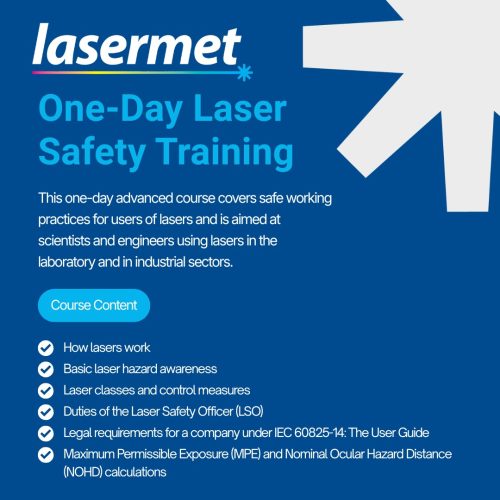
A comprehensive, robust laser safety training course should cover:

Get Laser Safety Training
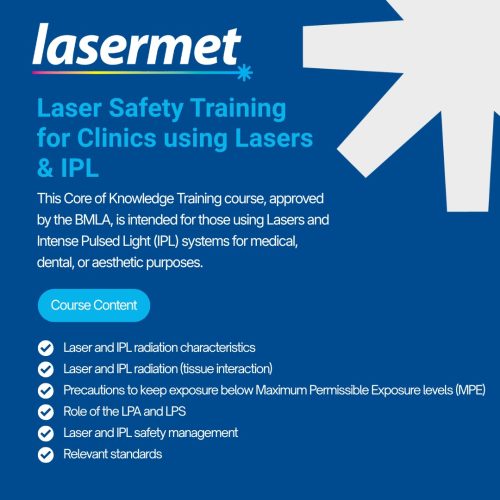
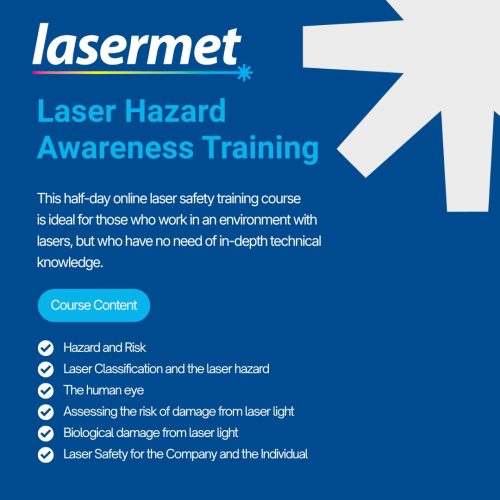
Lasermet provides a range of professional laser safety training courses designed to support compliance with UK, EU, and international safety frameworks. Courses cover key topics such as laser hazard classification, risk assessment, control measures, safe systems of work, and the responsibilities of Laser Safety Officers and operators, with options for on-site or online delivery.
Disclaimer:
This article provides general information only and does not constitute legal advice. Laws and regulatory requirements for laser training vary by country and can change over time. You are responsible for checking and complying with the specific legal requirements, regulations, and guidance applicable in your own country, region, and industry. When in doubt, consult your local regulator or a qualified legal or safety professional.